Valery Dunaevsky| Salute to the Italian Sons and Daughters of America!
A 50-foot-tall bronze and granite monument of Christopher Columbus in Pittsburgh’s Schenley Park. From left to right:
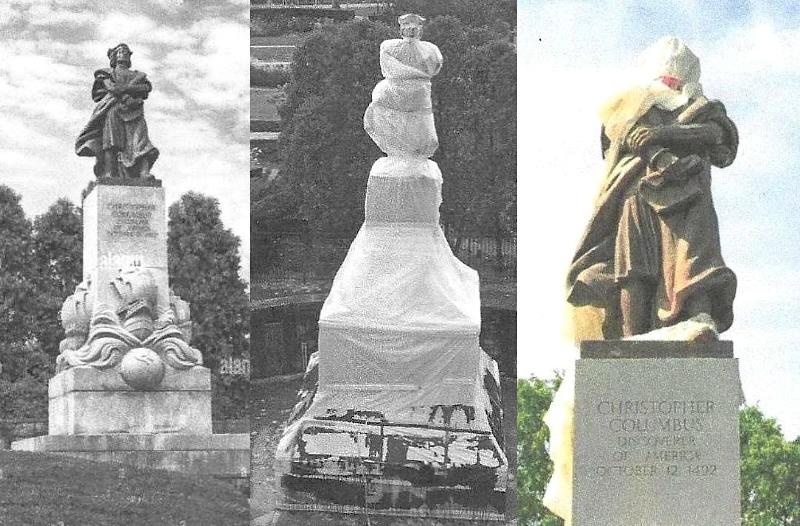
– The unobstructed view
– Wrapped in plastic film since October 2020 and ready for transfer to storage (circa 2021)
– With a partial covering by weather-worn pieces of plastic (circa Spring 2026)
The provided essay touches on several instances of insensitive US policies at both the local and federal levels, highlighting how these actions reflect a failure to reckon with human suffering and complex historical symbols.
While America has achieved many notable milestones, certain historical policies can be critiqued to assess whether the nation has upheld its professed moral principles. One particularly troubling aspect is America’s response during the Holocaust, a topic heavily explored in scholarly works, with recent publications shedding additional light on these inadequacies. This discussion is especially relevant given the recent American semiquincentennial celebrated on July 4, 2026, marking 250 years since the adoption of the Declaration of Independence.
Many contemporary studies on American policy regarding the Holocaust challenge the traditional view of President Franklin D. Roosevelt as a humanitarian savior during this period. Key points from these studies include the following:
Policy Failures. The opportunities were missed for the rescue of or aid to eventual Jewish victims, such as the infamous turning away of the refugee ship St. Louis and the refusal to bomb rail lines leading to Auschwitz, which had the potential to slow the rate of the killings.
Suppressed Immigration. The Roosevelt administration actively discouraged and disqualified potential Jewish immigrants, resulting in the suppression of immigration far below established quota levels and eliminating a viable method of escape for many future victims. The Administration produced only a few and limited in their action initiatives to address the rescue of the potential victims of Nazism.
Private Prejudices. The historical research accounts for the prewar isolationism and antisemitism that affected the Administration’s policies. Still, it also points to private statements by FDR expressing a personal mistrust of Jews and a desire to limit their influence in certain professions.
Silencing Dissent. FDR and his allies pressured prominent American Jewish leaders like Rabbi Stephen S. Wise to stifle public protests against the Administration’s inaction. “Ironically, Roosevelt’s lack of concern for the Jews seemed to matter little to his Jewish supporters, who remained loyal to the Democratic Party…” 1The book further notes that “Had FDR not died in April 1945, it is doubtful whether Israel would have come into existence at all.”
Overall, “The American State Department … had no intention of rescuing large numbers of European Jews.”2 Saving Europe’s Jews was not a primary military or strategic goal for the United States government or its military forces during World War II. Unfortunately, all participants in the anti-Axis coalition held this position. With all that said, the author recognizes that without the decisive and relentless prosecution of the anti-Hitler war by US forces, along with America’s tremendous military and humanitarian assistance to its allies, the situation for the Jewish population and many others would become significantly worse.
Following the previous discussion of failed federal policies regarding human suffering, the next section of the essay addresses the local government’s insensitive attitude toward a complex historical symbol: the Christopher Columbus monument in Pittsburgh’s Schenley Park. The essay also highlights the local Italian fraternity’s resistance to it.
Throughout history, competing theories have surrounded Columbus’s heritage. Traditionally considered an Italian born in Genoa in 1451, Columbus later lived in Portugal and sailed for the Spanish Crown. For over a century, circumstantial evidence has also suggested he may have had Jewish roots. For example, according to (https://www.youtube.com/watch?v=u0yoVsZfypQ), Columbus was the illegitimate son of a Portuguese prince—the Duke of Beja—and a Portuguese mother of Jewish descent, the daughter of the Portuguese navigator Zarco, who had converted to Christianity.
A 2024 DNA study by the University of Granada using the remains of Columbus and his family appears to support this conjecture, concluding that his DNA is compatible with Sephardic Jewish and Western European origins. It suggests he may have been born in Spain and concealed his heritage to avoid religious persecution. However, because these findings were presented in a television documentary rather than a peer-reviewed journal, independent scientists note the raw data has not been fully evaluated. Mainstream historians continue to rely on 15th-century archival records supporting his Genoese birth, leaving the question largely open.
To lighten the mood while we discuss this complex topic, I would like to share a verse by Igor Guberman, a Russian-Israeli poet and satirist, regarding his definition of Jewishness. His humorous verse suggests that all people are Jews, but only a few dare to admit it openly.
Igor Guberman
“Везде одинаков господен посев
И врут нам про разницу наций.
Все люди евреи, но только не все
Нашли в себе смелость признаться.”
The Lord’s sowing is the same everywhere,
And they lie to us about the difference between nations.
All people are Jews—only not everyone
Has found the courage to admit it.
Beyond the mystery of Christopher Columbus’s origins, an even greater question remains regarding his true identity, which he never disclosed to his children. Some speculate he may have been a secret agent for the Portuguese king, involved in dividing the world between the Portuguese and Spanish crowns.
Regardless of these theories, the 50-foot bronze-and-granite monument of Columbus in Pittsburgh’s Schenley Park exists today thanks exclusively to the Italian Sons and Daughters of America. The organization actually erected the monument and has consistently defended it in the prominent legal battles against the city’s attempts to remove it. These removal efforts have stemmed from pressure by various groups due to the alleged controversies surrounding Columbus’s legacy and his impact on Indigenous peoples.
The fraternity maintains that the monument represents vital Italian-American heritage. Funded by small community donations, work on the monument began in the early 1950s. The late Italian-American artist Frank Vittor designed it, and it was officially unveiled in 1958. For many years, the society has resisted the Pittsburgh Art Commission’s attempts to remove the monument. While these preservation efforts have prevailed so far, the monument’s long-term status remains uncertain.
References.
Larry Schweikart and Michael Allen, A Patriot History of the United States: From Columbus’s Great Discovery to America’s Age of Entitlement, 15th ed. (Random House, 2019), 644.
David S.Wyman, The Abandonment of the Jews. America and the Holocaust. 1941–1945. (New York. Pantheon. 1984), x.

Учёный, публицист, автор и соавтор нескольких книг Валерий Дунаевский (Valéry Dunaévsky), PhD, специалист в области прикладной механики, увлекающийся также литературным творчеством и журналистикой

Комментариев нет:
Отправить комментарий