Leonid Goldin | Psychosis Cannot Be Cured by Rhetoric
We live 10 minutes away from the Central Synagogue, and we’ve been coming here for Shabbat for many years. We were here back when Larry Montes, a 46-year-old Bronx resident, caused a disturbance: he interrupted the service, tried to make his way onto the podium toward the rabbis, knocked over antique floor candelabras, spat on and struck a woman and a security guard in the face, shouted “Pigs,” “You’re not Jews,” and resisted arrest.
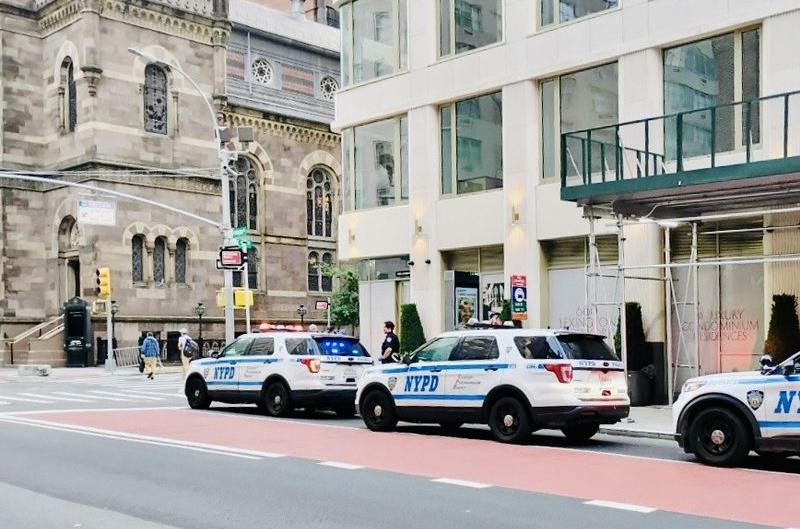
Фото Леонида Гольдина
After being elected mayor, Zoharan Mamdani fulfilled his promise—he removed police protection from the synagogues. The Central Synagogue has its own security staff with metal detectors and bag checks, as well as police officers working overtime; the synagogue pays for their services. Several police cars arrived in response to the call, and the intruder was quickly taken away.
There were 500–600 people in the synagogue during the incident. There was no panic, but some of the congregants left. The service continued in its usual tone: truth and justice will prevail, and everything will be all right.
Against the backdrop of the current atmosphere in New York, the incident did not seem unique. Jews account for up to 60% of hate crimes. Scandalous displays of anti-Semitism have become normalized; attacks and insults against Jews are almost daily occurrences; and mass anti-Zionist and pro-Palestinian hysteria is part of everyday life. Government officials will offer the ritualistic statement, “There is no place for hate in New York”—yet the absurdity of such a declaration in a city where hate is cultivated from the streets all the way up to the authorities does not bother anyone.
New York City Police Commissioner Jessica Tish, a member of the Central Synagogue congregation—where her wedding ceremony took place—undoubtedly found the incident extremely painful, but she can hardly do more under the current circumstances than issue yet another statement condemning violence.
Mamdani also offered some words appropriate to the occasion. I shudder to think that if he were to visit the Central Synagogue—a bastion of the liberal-Reform movement—he would be greeted and escorted out with applause. This wouldn’t be the first time for him; many American Jews haven’t lost hope that love, friendship, and good deeds will prevail.
I didn’t write about this incident right away because there are many well-known and influential Jews among the members of the Central Synagogue—including those in the mainstream media—who would cover it more quickly and reach a wider audience.
Indeed, although the incident did not result in serious consequences, it was widely covered in the mainstream media. Almost all of them reported on it with caveats: Larry Montes had a criminal record; his family says he had a difficult life; he is mentally unstable. The subtext is obvious—well, what can you do? The man isn’t responsible for his actions; circumstances and illness are to blame for everything.
Israeli Ambassador to the UN Danny Danon and Israeli Consul in New York Ofir Akunis said that the incident was a direct result of Mamdani’s anti-Semitic, anti-Israeli rhetoric. One can understand the feelings of the Israeli diplomats, but it would be half the trouble if Mamdani were the only cause. The main issue is the state of the society in which he won a decisive victory. Antisemitism is political capital, and today it is in mass circulation; Mamdani is no exception.
This episode did not give me any new impressions or insights about the city or the times. But once again, I was able to confirm the great wisdom of the Talmud: There is a tractate in the Sanhedrin that states people can view the same event—even a murder—in different ways. The disturbance at the Central Synagogue: for some, it is a failure of the healthcare system, which did not provide adequate assistance, or of a liberal justice system, which left him at large after his arrests. On the streets of major cities, there are many thousands of people with severe mental disorders; they are unsupervised, and police cannot determine in advance who is entering a house of worship and with what intentions. Few people want to consider the deeper and broader causes. After the service, some congregants said that Montes shouted, “Kill Jews.” Others did not hear this.
The Central Synagogue broadcasts its services live, and a wide range of opinions about the incident are being shared on social media. Among all the information, my attention was particularly drawn to reports in *The Forward* and *The New York Post* stating that Montes was obsessed with Jewish life and Judaism and had expressed a desire to convert. He posted a video online comparing Mamdani to Ayatollah Khomeini. But after his arrest, Montes confessed to the police that he was motivated by hatred toward Jews and Black people.
There is no doubt that Montes’s psyche is shattered and in need of healing. There is no doubt that his lawyers will try to portray him as completely insane to avoid or mitigate his punishment. But there is also no doubt that the trigger for his psychopathy was the toxic atmosphere in New York, where, amid an endless array of difficult and dangerous problems, anti-Semitic frenzy and hatred of Israel have taken center stage.
The Reform movement dominates among American Jews; it actively supports the Democratic Party, fights against Trump, and sharply criticizes many aspects of Israel’s policies as well as the way of life and beliefs of Orthodox Jews.
Reform Judaism originated in Germany in the early 19th century. After emancipation, Jews left the ghettos and hoped to become full-fledged citizens of the country. The first Reform synagogue opened in Hamburg in 1818. Sermons were delivered in German rather than Hebrew; men and women sat together; and an organ was played. A radical departure from Orthodoxy was the recognition that the Torah was not dictated by God but is a creation of the human spirit. The focus is on ethics, justice, and mercy, rather than on prayers and kashrut.
Chief Rabbi Angela Buchdahl of the Central Synagogue is the embodiment of American Reform Judaism. She was formerly a cantor and has served as chief rabbi since 2014—the first woman in the community to hold this position. Her father is an American Jew, and her mother is a Korean Buddhist. She graduated from Yale University. She led Hanukkah services at the White House during the Obama administration. She is the author of the bestseller *Heart of a Stranger*. She readily converts people to Judaism, performs same-sex marriage ceremonies, and works hard to build bridges with Black and Muslim communities, though mutual support is not yet evident.
For Orthodox Jews, Reform Judaism is not Judaism. With my limited knowledge, I think that after reading the Torah and the Gospel, it becomes clear that Reform Judaism is closer to Christianity than to the Tanakh. At first, there was a fierce struggle between the Orthodox and the Reform. Then a period of neutral coexistence set in; at least there were no major public disputes or accusations. Today, there is no unity either within Reform Judaism or among the Orthodox and Hasidim. There is no talk of reconciliation, even in the face of threats to Israel’s existence and global anti-Semitism.
The Torah and the records of Jewish history are full of evidence of endless Jewish strife. The painful past has not served as a lesson. Even after World War II, the Holocaust, and the establishment of Israel, relations have not softened. Chaim Potok recounted this period in the history of American Jews in his wonderful book *The Chosen*. Here, the guardians of tradition—faithful to every word of the Torah—clash in an uncompromising battle with modernists who seek to enter the new world without losing their faith. Parallels can be drawn, but there is a significant difference: in the 1940s, it was a battle over faith and way of life between intellectual giants; today, the disputes are more about group interests and dominance.
I cannot resolve these contradictions; I live with them in two worlds. On Friday evening, I go to the Central Synagogue, a building of astonishing beauty in the Moorish style, with magnificent musical accompaniment—a snapshot of Jewish liberalism in action. It must be said that since Mamdani’s election, there has been a noticeable decrease here in propaganda supporting the Democratic Party and in criticism of Trump and Israel. Many synagogues are losing congregants and can’t gather a minyan, but the Central Synagogue is full—it’s the most popular in America—and it’s fascinating to observe its life. Increasing assimilation, a liberal, cosmopolitan worldview, mixed-gender and same-sex marriages, a low birth rate—does Reform Judaism have a future?
I am Ashkenazi; I don’t know Hebrew, and I can’t make sense of the logic and casuistry of the Talmud, Halakha, and Kabbalah, but on Saturdays I go to an Orthodox Sephardic synagogue, where they believe in the God of the Torah, where they know and respect the laws and traditions, and where there is a spirit of community. There are no neurotic “heroes” like those of Woody Allen and Philip Roth here. These are healthy, well-rounded people—true Jews. They are the guardians of the Covenant, the guarantors of the future.

Комментариев нет:
Отправить комментарий