Leonid Goldin | The Triumph of Chaos
One must carry chaos within oneself to give birth to a dancing star.
Friedrich Nietzsche.
Equilibrium is a rare and dangerous state; chaos is the norm.
Ilya Prigogine, Nobel laureate.
Without Prophets or Predictions
It is commonly believed that mental chaos—the culture shock that overturns preconceptions and expectations—is an inevitable stage in an immigrant’s adaptation to new conditions. For me, it was bookstores and libraries; what was not always available in the professors’ reading room of the Lenin Library was here in the open—a wealth of literature I had no idea existed. An instant cure for status and erudition syndromes.
The working conditions were also shocking. In textbooks on philosophy, sociology, and political economy, the portraits and text about Marx were larger than those of Locke and Smith. A Marxist professor—a socialist, perfectly legally—was cooler and more popular than a boring reformer or free-market advocate. Conservatives, defenders of the status quo, were cornered and feared the students more than the administration. Academic freedom ends where anti-Western political correctness begins.
The loudest and most demanding are people of color, women, and gay people. For a white man, getting a full-time position in the social sciences is a dead-end task. Most instructors are powerless part-timers: their workload is heavier, their pay is lower, and they have no benefits. A professor’s status and income are no match for those of a restaurant owner or a stockbroker.
There were some pleasant surprises. At university graduate and doctoral centers, you can attend and participate in seminars and conferences featuring world-renowned experts every day, free of charge. With my Soviet background, I even aroused some curiosity and was always given a chance to speak, but I quickly realized that the tone of the discussions leaned radically to the left: anti-colonialism, the struggle against the establishment and privilege; Ayn Rand and Milton Friedman, apologists for the elites and the market, were there only to be criticized. But neither Rand nor Friedman are my heroes.



My transformation from a liberal to a non-aligner—without icons or ideologies—happened very quickly, and the decision never to vote for or serve any political side came even before I received citizenship.
Thirty-one years of living and working in America, amid the neon glitz and grimy squalor of New York City, are enough to build up immunity to surprises. And yet, just recently, during a morning walk from my home to the park by the East River, I couldn’t believe my eyes when I saw an abandoned treasure—a huge library of academic publications on philosophy, sociology, and political economy.
Every intellectual from the world’s most book-loving country will understand me. A home library spoke volumes about your identity, values, and status. Having Kierkegaard, Nietzsche, and Spengler in your library was equivalent to owning a Bentley, a Patek Philippe, or a Kiton K-50 today.
I could take only a few books; I myself was under intense pressure to cut my library in half. Some books bore the surname of the owner of these treasures: JC Spender. AI told me about him: an electrical engineer, a former submarine officer, a doctor, and a professor of management who revolutionized the understanding of and approach to business management. In very general terms: business is not a science, but entrepreneurship—an art; a broad perspective is more important than statistics, calculations, and models.
I didn’t need convincing of this; in Moscow, my main work had been focused on management departments, where the classrooms were filled with people who had experience, degrees, and dissertations—models and algorithms didn’t interest me, and my course was based on philosophy and social psychology.
We ended up being neighbors. My new acquaintance didn’t have those big American smiles; at first glance, he seemed like a “no-nonsense” type—no small talk, no “nice to see you,” no “have a good one.” But he had a sense of humor and a touch of self-deprecation; he wrote in an email: “I am embarrassed by my ignorance.” I’d never heard anything like that in America; self-confidence and the right to judge everything and everyone are cultivated starting in school and are perceived as signs of a healthy mind and free thinking. A job candidate’s resume is like a presentation for a Nobel Prize; in my opinion, it’s a case of megalomania masking an inferiority complex. I’ve been fortunate enough never to have to write such a self-praising document about myself.
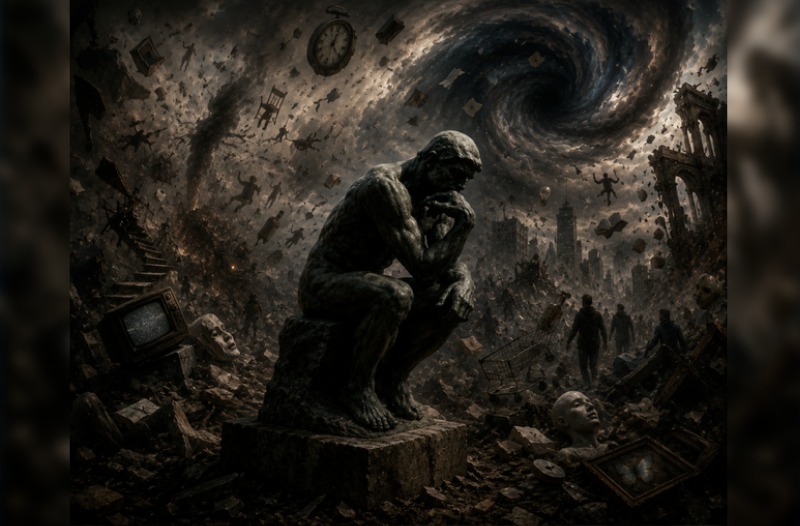
Our conversation focused on a shared topic of interest—uncertainty as an ontological category, the fundamental state of existence and thought. The era of Bacon and Descartes—“Knowledge is power”—has ended; faith in the enlightenment, science, and intellect has collapsed; the temples of axioms and dogmas have been destroyed; uncertainty is not a temporary state but a law independent of will and consciousness; today it has been laid bare and has triumphed over vain rationalism. The end of politics, ideology, planning, and predictions—there is no truth and no lie. It is too late to bless or hate; the point of no return has been passed. There are no more full stops, only ellipses.
Religion could triumph—faith has endured and grown stronger amid the chaos on the ruins of science. “I believe because it is absurd,” Tertullian’s maxim, rings true today. But Tertullian spoke of the grandeur of God’s plan, not in praise of folly and ignorance. The Talmud, Kabbalah, Rashi, Maimonides, and Nachman, as well as the Evangelists, Augustine the Blessed, Thomas Aquinas, and John Chrysostom, would not have tolerated any doubts about the power of reason and knowledge—the path to divine revelation. God is absolute reason, and the world is rationally ordered. To live in harmony with God, one must be guided by reason.
In Soviet social studies, absolute uncertainty was rejected as an idealistic concept: Marxism-Leninism and practice overcome ignorance and doubt and lead to objective truth. This is the subject of Lenin’s major philosophical work, *Marxism and Empirio-Criticism*, in which he lambasts his party comrades Bogdanov, Lunacharsky, and Bazarov for agnosticism and the search for God.
There is no irresolvable contradiction between chaos and reason. Chaos is a true, objective state, and reason acknowledges it. Recognizing the truth of chaos expands the scope for new knowledge, but it does not ensure order, peace, or prosperity; Solomon warned: “In much knowledge there is much sorrow.” Heraclitus of Ephesus wrote 500 years before the Common Era: “Much learning does not teach the mind.” Nietzsche: “Look into the abyss, and the abyss will look into you.”
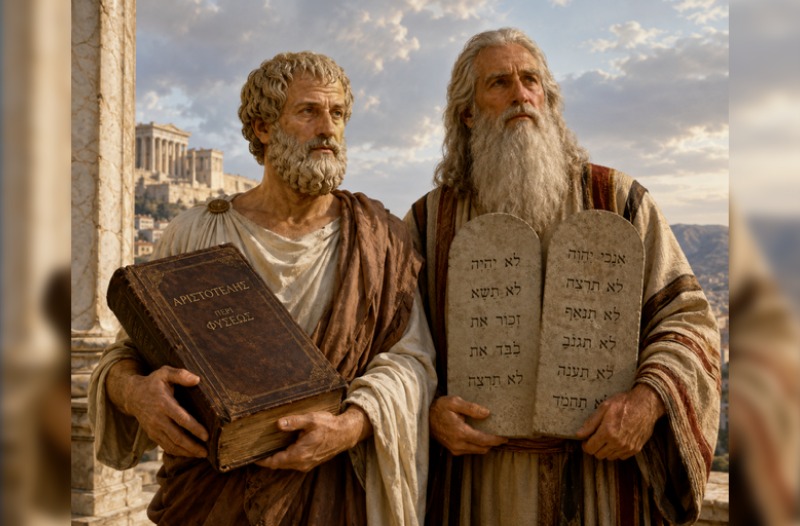
We must recall Lev Shestov—Lev Isaakovich Shvartsman, a baptized Jew and defender of the Jewish people. An apologist for chaos, he fought against the rationalists and sought to lead the Jews back to God, not to Spinoza. Reasoning is poison; faith is salvation. His dichotomy is interesting: Athens—reason, certainty; Jerusalem—faith, miracle. For Athens, 2+2=4; not even Zeus can change that. For Jerusalem, if God wills it, the answer will be 5 or whatever is needed.
Uncertainty is the topic of the day. People with no background in quantum mechanics cite Heisenberg’s universal theory of uncertainty to justify being late for a meeting. Religious people say, “If it be God’s will.” At international forums and presentations, politicians and oligarchs quote Heidegger—being and meaning are rooted in uncertainty; Wittgenstein—language and knowledge have no fixed rules, and meaning lacks certainty; Derrida—meaning depends on interpretation and always eludes us; and Popper—science proves nothing, only refutes; all knowledge is hypothetical.
At intellectual gatherings, postmodernism, structuralism, Freud, Jung, and Frankl are out of the question—they’re unsuitable. On the topic are Foucault: there is no truth, no man, no freedom; it is not you but others in your head; the world is known only through madness; Locan: chaos, trauma, a crippled language, emptiness. The highest truths in chaos are revealed by hallucinogens.
Professor Spender introduced me to a new name and concept: Frank Knight, an influential American economist and one of the founders of the famous Chicago School. Knightian uncertainty is when the future is completely impossible to calculate and evaluate in terms of mathematical probability, and to predict the outcome or result. This type of uncertainty is associated with unique, unprecedented events that have no analogues. It is absolutely impossible to create a model or foresee the social impact and consequences. The logos of chaos: 2+2=unknown. Examples: global pandemics and nuclear war—whether planned or accidental, global climate catastrophe, artificial intelligence, genetic manipulation, and contact with other galaxies.
Entrepreneurship is always a leap into uncertainty. One could go on—in any field of activity and even in personal relationships. It’s either win or lose. Either law and order, or a dancing star. It’s striking, but Knight was the teacher of Milton Friedman, the champion of calculations—for whom 2+2 always equals 4, the criteria being monetary phenomena and interest rates, forecasts, and strategies for a hundred years.
It seems to me that Knight, not Friedman, would have won the Nobel Prize today. Knight’s theory describes our times very accurately and honestly. It doesn’t suit anyone—neither those who claim to know and make promises, nor those who listen in the hope of finding peace of mind and soul. But we’ll have to live by Knight’s rules.
I am not a disciple of Knight. For him, chaos and uncertainty are different worlds. He confined chaos to the realm of economics and did not cast Smith and Friedman aside. The risks of uncertainty can be calculated. Chaos defies measurement. Total, universal chaos is not Knight, but Shestov. In my understanding, chaos is the highest stage of uncertainty. We are now somewhere between them, caught between the charms and curses of two worlds. We have lost faith in Athens, but are too weak for Jerusalem.
Adrift without a rudder
In the not-too-distant past, with few exceptions, it was possible to foresee the life of a generation: familiar social structures and relationships, with children reproducing their parents’ social status, place of residence, occupation, religion, education, and way of life and thinking. People knew nothing of distant lands and gave them no thought.
After the victory over fascism, there were expectations of global stability; the United Nations was established in the hope that the power of goodwill, dialogue, and treaties would prevail. Although the world was soon divided by the Cold War, the lessons of the recent war and the threat of mutual annihilation by nuclear weapons served as sobering and deterrent factors.
Samuel Huntington and Bernard Lewis wrote about the inevitable clash between Western civilization and Islam, but even September 11 and October 7 did not prove to be the moment of truth. The West did not foresee the shift in relations with China and Russia, the mutation of Europe, the collapse of globalism, and the collapse of hopes for the worldwide triumph of liberal democracy.
Universities and the media were dominated by the fantasies of Francis Fukuyama, Thomas Friedman, and Fareed Zakaria about the worldwide triumph of globalization and a world order based on freedom and cooperation. This was a challenge to the doctrine of the worldwide victory of communism, but both theories turned out to be utopian.
In my view—which I do not impose on anyone—the critical theory of the Frankfurt School proved to be the closest to understanding the real situation. Its founders, refugees from Nazi Germany, believed that faith in reason, scientific, technological, economic, and cultural progress had turned into a new form of barbarism; that knowledge and achievements serve as instruments of total control by the ruling minority; that education, mass media, and mass culture have become commodities; that ideology has deprived people of critical thinking; and that this way of life has led people to become alienated from their true nature and their relationships with others.
The Frankfurt School recognized that capitalism had integrated the working class, which had lost its revolutionary potential; today it is evident that it will soon be unnecessary even for exploitation. The new revolutionary class consists of outsiders, marginalized people, and the declassed: people of color, youth without hope or prospects, the radical intelligentsia, and—under current conditions—millions of illegal immigrants.
They will not be able to carry out a revolution, but they will ignite and shatter the system. This is Leninist tactics: action first, to hell with theory if it gets in the way of seizing power; a spark will ignite a flame; the plan is born in battle; the main thing is to clear the way,
It’s not a matter of whether one likes the Frankfurt School or not; today, it very much seems that its predictions are coming true. Socialist Democrats—comrades Mamdani and Ocasio-Cortez—haven’t studied *Capital* or *The State and Revolution*; they don’t know Horkheimer, Fromm, Marcuse, or Adorno, but they’re marching toward power, sweeping aside their opponents through liberal ideology, free speech, protests, and elections.
Their mindset and creed: “Everyone owes us; it’s time to settle the score for colonialism, racism, oppression, and discrimination—we have nothing to apologize for.” Their mission is not to build, but to destroy, and they are successfully carrying out this mission in California, New York, Massachusetts, Illinois, and Minnesota; they are taking over cities in Pennsylvania, Michigan, Arizona, and even Texas.
Marx would have turned away in disgust from today’s socialists, but in America the word “socialist” is no longer a curse, and they have managed to make the majority fear them and repent.
Global and domestic chaos is fueling the rapid rise of progressives. They possess passion, fervor, populist demagoguery, and the aura of martyrs fighting for rights and justice. On their side are the education system, the mainstream media, social media, and liberal legislation. They get away with pogroms, assaults, and threats of violence. A few hours in custody turns them into heroes. Neither the president nor the State Department has the authority to ban a radical organization or deport a foreign activist who spreads hatred if that person has obtained citizenship.
Is there anything encouraging to be found in the current situation? Yes, there is. Progressives are shattering illusions about the benefits of social harmony and the social contract. They are blowing up liberal democracy from within, undermining its foundations, yet are incapable of offering anything but demagoguery and false promises. They are parasites on the body of the system, and by destroying it, they are dooming themselves to annihilation. The aggressive advance of the progressives has a byproduct: the awakening of consciousness and an understanding of reality. Europe has woken up, but too late. America still has time.
The Geopolitics of Chaos
People in the Soviet Union had hope—either the next party congress and a new general secretary would resolve everything, or the system would collapse, and a bright future modeled on the West would prevail. In the West, all hopes were pinned on new elections and a new head of the Federal Reserve. But today, the prospects for the election campaigns and their outcomes inspire more fear than hope.
No matter where you look, you won’t find any good examples or models. Europe is lost to itself; as for China and Russia—God forbid. Iceland and Norway, with their social benefits and no military budget for America, are no model to follow. And one would have to be a true optimist to hope that the next president will bring order to the country, the world, and the minds of his fellow citizens.
The moral state of the West is fully reflected in its foreign policy. Despite all its economic and military superiority, it cannot stand up to an adversary for whom the destruction of its own country and the sacrifices and suffering of its own people are the primary weapons. Looking to the future, one recalls the fall of great empires and civilizations, and the triumphs of barbarism.
Barbarism takes many forms, ranging from the savage Hussites who terrorize global trade—and whom no one can control—to artificial intelligence; where will it lead in the hands of terrorists, swindlers, and madmen? Or in the hands of a dictator, a corporate CEO, or a chief of military staff—and when will it inevitably slip beyond all control?
It took a hundred years for Einstein’s theory of relativity to receive experimental confirmation. But theory of absolute uncertainty requires neither such a long time nor special experiments to be confirmed. The realities of everyday life serve as convincing proof. And the zone of uncertainty is rapidly expanding.
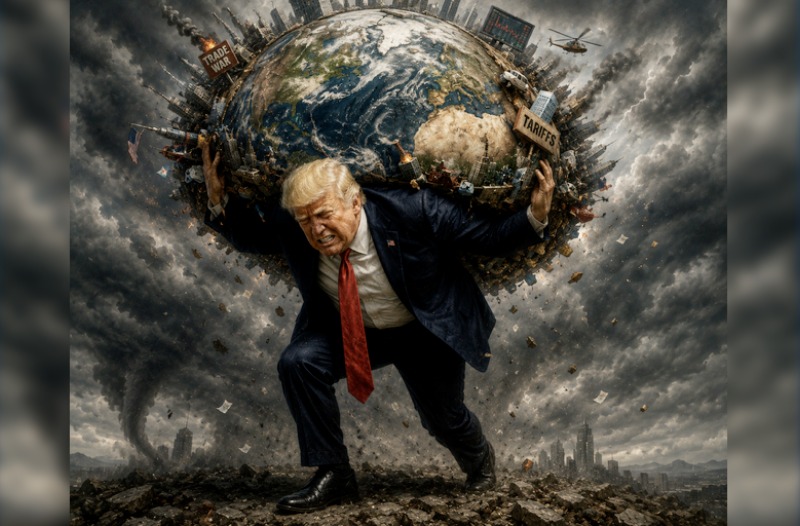
Trump is the president of a country in chaos—and, given America’s role in the world, of global chaos. I don’t think he’s read Knight and Shestov, but his thinking and behavior fit perfectly within the theory of uncertainty. In Nietzsche’s words, he is a star dancing in chaos. He did not create this chaos; the world has become a highly interconnected system, has grown more complex, has overheated, and has accumulated a colossal amount of negative energy that the system cannot process. Order is collapsing; information cannot be processed fast enough; everyone is on edge, in a state of hysteria and agony. The laws of entropy, uncertainty, and chaos are uncontrollable.
Under current conditions, developing long-term plans and strategies is, if not absurd, then naive; what strategies can we even discuss when the world and the country are in convulsions, in a state of hysteria, and it’s impossible to determine where the next step or the next day will lead? There are no good options. The human psyche and the mechanisms of civil society cannot withstand the daily news cycle; there is no trust in institutions, parties, leaders, or authorities.
Amid the chaos and hopelessness, the world has focused its attention on the Jews and Israel. Medieval slanders have resurfaced, and antisemitism has gained a broad platform in the media, education, culture, and the internet. The war with Israel’s existential enemies has further complicated the situation. Yet the entire history of Israel and the Diaspora is a history of uncertainty. There is also a sense of predetermination: sooner or later, when the illusion of peace, tranquility, and recognition arises, the prophecy of Ecclesiastes is fulfilled—“What has been will be again.”
The main motive for emigration among Soviet Jews was to escape anti-Semitism. Many lost their professions and status, and parted ways with their familiar surroundings and loved ones in order to rid themselves of a centuries-old curse. What is happening today was unimaginable. Columns of anti-Semites are marching through major cities, supported by the media, members of Congress, and celebrities; Jewish children are being harassed in schools and universities; people are afraid to wear a kippah; synagogues are under martial law; and to make matters worse, many American Jews are showing solidarity with Israel’s enemies. October 7 turned into an international orgy of hatred and accusations of the Holocaust.
When the war in Iran began, it seemed the moment of truth had arrived. That hope quickly died. For me, the agreement in Islamabad is a clear capitulation by America. Although Israel’s enemies have been weakened, in a world of chaos and absurdity, the agreement looks like a victory for Iran and its satellites. America has once again demonstrated to its enemies its vulnerability to an ideology that cultivates death and destruction as the meaning and purpose of existence. The Arabs have a saying: “If you can’t kill a snake, don’t pull its tail.” The Chinese have an even sharper one: “If you don’t finish off the snake, you’ll bring trouble upon three generations.”
But we must ask: Who would have been better than Trump? Did Trump have a better solution? Send ground troops to Iran? Strike with bunker-busting bombs and ballistic missiles? With what warhead and against which targets? How should one respond to the scale of casualties and destruction, to the global reaction and the reaction within one’s own country? How will this affect the elections, and whose path to power will it pave? The methods of World War II are unacceptable in the modern world, and not only Israel but also America cannot live in a state of self-sufficiency and isolation.
Can Trump be blamed for not making Israel’s interests his priority? For any leader, the interests of their country, their party, and their approval ratings are absolute priorities. For a president who entered the White House under the “America First” banner—in a country that is divided and weary of American foreign commitments and problems—he cannot have any other priorities.
And besides, there’s the human factor: what does Trump owe to American Jews, the overwhelming majority of whom voted against him twice, even though no president has done as much as he has to support Israel and combat anti-Semitism? His representatives in the Middle East conflict are the Jews Kushner and Witkoff. His ambassador to Israel is the Zionist Huckabee. This is a slap in the face to anti-Semites. Jews, don’t you like Trump? Do you have better candidates? Don’t you want Mamdani or AOC in the White House?
Since biblical times, Jews have been lighting candles—stars in the darkness and chaos. In Sholom Aleichem’s *Wandering Stars*, Jews become stars, gain worldwide recognition, and their talent brings light to the whole world. The price: the loss of God, their roots, their families, and loneliness. Little Israel is the top story in world news, yet it has not found its place amid global and domestic chaos. The Diaspora has awakened—we are guests, and not welcome by everyone. Gevalt! The world has fallen apart—God, where are you! A groan and a plea for Moses, for the Moshiach.
We can call for a new strategy and rely on our own strength, but 70% of Israel’s weapons and defense spending depends on America. Without global cooperation, we cannot survive boycotts and sanctions. What to do in Judea and Samaria, who should serve in the army, what powers the branches of government should have, how to build relations with the liberal Jewish diaspora, and how many more years the country can be kept in a state of constant strain—these are not matters for discussion by Netanyahu, Lapid, Bennett, and Smotrich—it is a rift at the very heart of Israel.
Israel has rid itself of leftism, the “peace activists,” and the “two states in peace and cooperation” narrative, but American Jews have understood nothing and learned nothing; politics, discourse, and public sentiment are shaped by liberals and reformists who serve the party that betrayed them—for them, Trump and Netanyahu are the source of all their woes.
Both enemies and friends are demanding concrete details and specifics from Trump and Netanyahu. The president and the prime minister have the world’s most powerful intelligence and analytical services, advisors, and experts, but this is not enough to overcome the chaos of the new world with plans and strategies. Trump acts on intuition; Netanyahu on experience. They don’t follow a map—they navigate the terrain.
Sitting in front of the TV, living on the internet, and dispensing advice on world politics and building the future may be therapy for a traumatized psyche, but it’s a foolish and useless pursuit. This isn’t about shielding Trump and Netanyahu from criticism and expressions of discontent. It would be good to protect oneself from losing touch with reality and slipping into delusions of grandeur. And at the very least, to ask: Who are you shouting at? Who will hear you? Who will follow your advice?
Being a leader of America and Israel in an era of global chaos and psychosis is like surfing a tsunami. To walk into chaos, into the unknown, along an unfamiliar path, while everyone curses and explains how things should be done. Under these conditions, God alone is the counselor and helper to Trump and Netanyahu—and to America, Israel, and all of humanity.

Комментариев нет:
Отправить комментарий