Valery Dunaevsky | On Newt Gingrich’s New Book “America’s Golden Age”
In this piece, the author shares his impressions of Newt Gingrich’s new book published a few days ago.
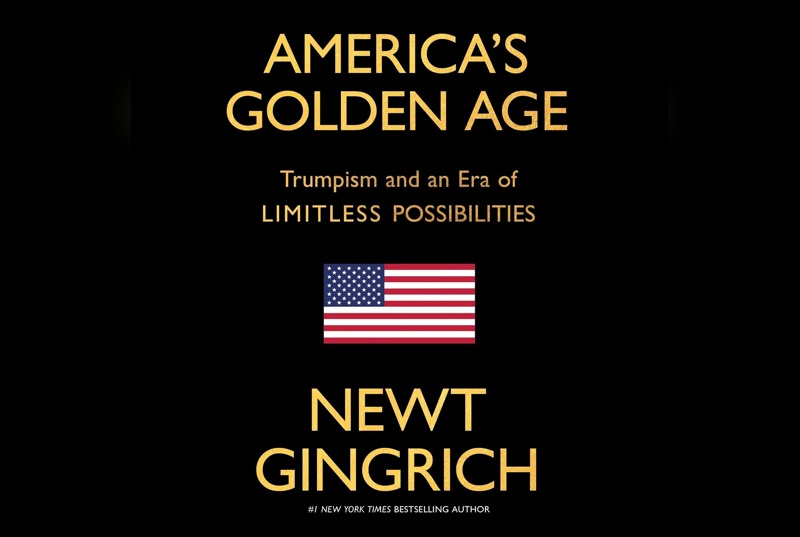
Although a local Barnes & Noble (the leading bookseller in America) that I visited recently carried large quantities of books across various genres—including many young adult titles, particularly those glamorizing and normalizing homosexual relations among schoolboys—the latest bestselling book by former (1995 to1999) Speaker of the House Newt Gingrich, America’s Golden Age, was surprisingly scarce. His book, which presents a bright vision for America 50 years from now through the lens of Trumpism, was available in only a single copy at this suburban location, which I was fortunate enough to purchase. Meanwhile, the bookstore proudly displayed well-stocked copies of the Quran and Marx’s Capital.
Newt Gingrich’s America’s Golden Age: Trumpism and an Era of Limitless Possibilities is a 2026 book that projects what the United States will look like in 2076 during its Tri-Centennial celebration. It argues that Donald Trump’s transformative presidency laid the foundational groundwork—cutting regulations, shrinking the scope of government, and boosting enterprise—needed to spark a national renaissance.
Gingrich explains, with informed optimism, how technological advancements will change the economy, improve national security, and improve our lives. For example:
– Through a combination of artificial intelligence, advanced robotics, and specialized materials, science will completely transform manufacturing;
– Small modular nuclear power plants will provide abundant, low-cost, carbon-free energy;
– Medical and biological advancements will dramatically extend healthy human lifespans, allowing today’s young adults to live active lives past 100;
– Rapid developments in space travel will transition the U.S. into a vibrant, space-exploring civilization, of which nearly 2 percent of the population will live beyond Earth.
Gingrich notes that this golden age is not guaranteed and requires overcoming real dangers, including political polarization, heavy-handed government controls (“Big Government Socialism”), and global threats like nuclear proliferation.
To clarify some of Gingrich’s concerns, the author lists several recent examples of political and cultural polarization that cast a long shadow on the impressive future Gingrich describes. One example is a California statute criminalizing voting officials for asking questions about voters’ citizenship. Another example is a threat from one of Michigan’s Democratic senators to university graduates about their potential future work in the Trump administration.
The third example raises concerns about the less-than-positive aspects of AI proliferation in day-to-day life: will it become our reliable tool, or will we, as humans, lose dominance? To illustrate AI intrusion even in the most mundane activities, the author reports the following. According to a recent WSJ article,2 college graduates face hurdles in securing a job. The article explains that part of the struggle to get a job stems from AI’s infiltration of the job application process itself. For instance, as employers are inundated with hundreds of applications, many made with AI or facilitated by it, companies are likewise employing AI tools to screen applicants. The article further clarifies the harms of this process. Finally, one more concern comes to mind. Its corrosive effect on all the plans Gingrich wrote about in his book could be palpable. It relates to a misconceived notion promulgated in some African American and the discriminatory DEI (diversity, equity, and inclusion) literature that traits such as objectivity, perfectionism, linear thinking, punctuality, a sense of urgency, and individualism are inherently “white” properties associated with white supremacy culture. This notion is one of the primary reasons for the low math and reading proficiency among students in standardized tests across many American schools.
Bibliography
1. Gingrich, Newt. America’s Golden Age: Trumpism and an Era of Limitless Possibilities, Nashville: Center Street, 2026.
2. Ellis, L. (2026, October 24–25). A Princeton Ph.D. Applied to More Than 2,300 Jobs. He Still Can’t Get One. The Wall Street Journal.

Учёный, публицист, автор и соавтор нескольких книг Валерий Дунаевский (Valéry Dunaévsky), PhD, специалист в области прикладной механики, увлекающийся также литературным творчеством и журналистикой

Комментариев нет:
Отправить комментарий