Leonid Goldin | Echoes of the Parade
We must love one another or die.
W. H. Auden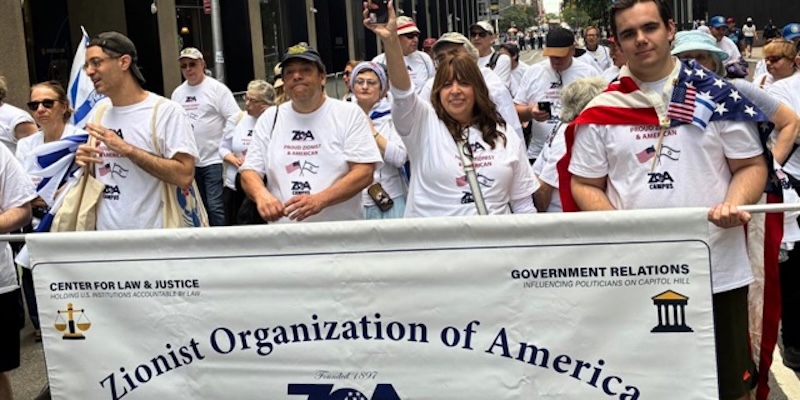
Down 5th Avenue—where to?
A vibrant part of New York City life is the mass celebration of the history, culture, and achievements of ethnic communities. I’ve been going to parades for 30 years; the atmosphere is usually like a carnival, open to anyone who wants to participate or watch.
The largest and most impressive gay pride parade, “Our Pride,” is a symbol of rights and progress for some, and Sodom and Gomorrah for others, but the former have won definitively and irrevocably. Pride—a very popular concept of self-worth in America—defines the meaning and intent of all parades, though it’s not always clear what this pride consists of or what its foundations are. But one can do without any grounds at all; in these times, high self-esteem—formerly called pride—is not a sin but a virtue and an advantage; you won’t achieve success and recognition through modesty and humility.



Initially, the parades were symbols of successful integration, social adaptation, and progress in social relations. But in recent years, isolation has become apparent; ethnic identity has taken on a dominant role.
In multicultural New York, there are more than 200 ethnic groups, hundreds of ethnic enclaves, and over 800 spoken languages. The number and proportion of people of color are growing rapidly; whites now make up less than a third of the population—and if we include undocumented immigrants, New York is an open city, the twilight of Western civilization will become even more apparent.
The city hosts over 200 ethnic street processions and parades annually, not counting spontaneous protests and rallies. The largest are the Irish, Puerto Rican, Israeli, Caribbean, Greek, and Italian parades on Columbus Day, as well as the New Year’s parade in Chinatown.
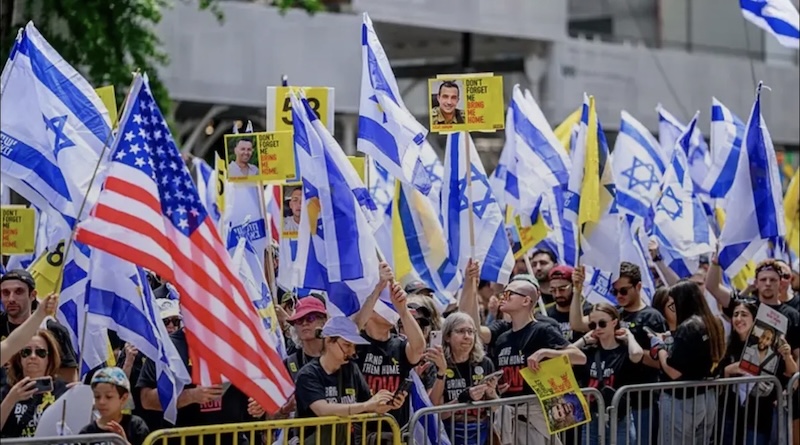
Iraeli parade has been held since 1964. This year, about 65,000 people participated, far more than usual. Police and private security were also present in record numbers. Throughout the entire parade on 5th Avenue, there were double barriers; it was impossible to get close from the side. Metal detectors, police dogs, and bag checks were in place; large bags, umbrellas, and flagpoles were prohibited. Some see these extraordinary measures as a sign of the government’s concern for Jewish safety, while others view them as a source of shame and disgrace, since nothing of the sort is required to protect other communities.
The parade’s theme is “One Nation. One Heart” and “Proud American. Proud Zionist.” Among the distinguished guests is Senator Charles Schumer. He tries to smile, joke, and look confident, but his role is unenviable. He is the Democratic leader in the country; New York is under Democratic control; Jews mostly vote for Democrats; yet the city sees daily anti-Semitic actions and incidents, and the threat to Jews is only growing. In the next election, Schumer will face a young, fiery progressive, and, as the mayoral election shows, it will be very difficult for an old-school politician to defeat his opponent.
Governor Kathy Hochul is also preparing for the election. It’s easier for her; she isn’t Jewish. She often speaks of the need to strengthen security at synagogues and of intolerance toward hate, but there is no mention whatsoever of the possibility of changing the situation and living without extraordinary security measures.
Kathy Hochul, together with Letitia James, the city’s attorney general, spoke out against the participation of Israeli Minister Bezalel Smotrich in the parade: “A far-right extremist whose rhetoric of hatred and destruction is fundamentally at odds with the values cherished by New York.” “Islamophobia has no place in New York.”
Smotrich draws on biblical history and believes that Judea and Samaria belong to Israel, and that Jews have the right to live there. I do not presume to judge his position. But it is a fact that the authorities allow pro-Palestinian activists to openly and with impunity call for the destruction of Israel, sow hatred, and create an intolerant environment for Jews. A call for a global intifada—a global war against Jews—helped an inexperienced and unqualified demagogue win the New York mayoral election. Does this contradict New York’s fundamental values? Or does hearing “baby killers” on the way to class and being afraid to go out in public wearing a kippah align with the new values?
A large delegation from Israel arrived at the parade: 13 Knesset members led by Speaker Amir Ohana, Israel’s Ambassador to the UN Danny Danon, four ministers, and 50 mayors of Israeli cities. The Speaker stated: “Terrorism must be eradicated, otherwise its supporters become mayors.”
For the first time in the history of Israeli parades, the city’s mayor was absent. Many are outraged by this. It is strange to hear these complaints. Would it have been better if an open anti-Semite had come with hypocritical assurances that there is no place for hatred and violence in New York, and calls to live in friendship and harmony?! He goes to synagogues with such speeches, and they applaud him. The city is filled with hatred and violence, and there are no signs that the situation will change.
Anti-Semitism has become political capital, boosting votes in elections and expanding audiences on media and social networks. 93% of Jews consider anti-Semitism a serious problem, and 78% do not feel safe. Religious Jews are in a particularly difficult position, as their appearance makes them an easily identifiable target. Most victims do not go to the police; it is useless. Anti-Semitism has been normalized in education, culture, and the media, and it dominates social media.
This year, unlike before, I didn’t walk in the ranks of the American Zionist Organization; in a column fenced off by barriers, you can’t see the big picture. After many attempts, I convinced a police officer to let me approach the fence and walk along the parade route. This time I didn’t see any rampaging Palestinians or their supporters; only after the parade, near Hunter College, was there a pile of their posters left behind.
They dispersed peacefully, wearing kippahs and carrying flags; the participants were in a festive mood. Chabad youth were offering tefillin. In the past, there have been attacks and insults directed at parade participants; as far as I know, this year passed without incident.
I had mixed feelings. Lately, Jews have had few reasons to rejoice; there are fruitless discussions and disputes, and a significant portion of the youth is critical of Israel and is turning away from Judaism. Anxiety is growing, along with uncertainty about the future. Trust in Jewish organizations is at a very low level. Under these circumstances, the parade is undoubtedly a positive event. It was especially heartening to see the massive participation of yeshiva students.
I was impressed by a group of university professors; for them, openly expressing sympathy for Israel and condemning its haters is almost a heroic act—I knew this well from my Soviet experience and now from my New York experience.
I spoke with several groups of young people. The most optimistic were the Lubavitcher Hasidim; they are not fazed by anti-Semitic demonstrations or an anti-Semitic mayor—the Messiah is near, and everything will be wonderful. A large group had arrived from Brazil, absolutely thrilled. A couple of years ago, I was in Rio de Janeiro; I visited synagogues and heard no complaints. But now, my interlocutors said, the situation has changed for the worse. I was lucky: I met a couple from Argentina, and they confirmed that President Javier Milei sees Israel as a friend and ally, calls himself a Zionist, and reveres Rabbi Schneerson. He is preparing for giyur—conversion to Judaism. Argentina has the largest Jewish community in Latin America, and although the country has painful memories of Nazis and Iranian terrorists who fled there, it was pleasant to learn of the president’s stance.
Reflection without predictions or hysteria
I do not write reports from the scene of events; that is not my field or my interest. I try to assess events from the perspective of their consequences and prospects, to highlight contradictions, to evaluate different viewpoints, and to avoid, as they say in America, “wishful thinking”—illusory thinking where an idea or proposal is not grounded in reality and does not stand up to critical analysis. It is helpful to believe that goodness, truth, and justice will prevail, but not necessarily in our time or on our planet. It would be good to avoid the worst as much as possible.
The parade is a call for unity, one that Jews have repeated since the destruction of the Temple as punishment for their strife and lack of love for one another. The epigraph to this article, from a poem by Auden written in 1939 at the start of the war, paraphrases the Torah: “Love your neighbor as yourself.” But after the war, Auden deemed this line a lie, cheap rhetoric, and made a change: “We must love one another and die.” In subsequent editions, he omitted this version as well, leaving the dilemma unanswered.
Theodor Adorno’s maxim gained widespread fame: “Poetry after the Holocaust is impossible.” More precisely: “To write poetry after Auschwitz is barbarism.” One might consider it barbaric to engage in futile searches for where God was during the Holocaust, and to exploit the tragedy for political and self-serving interests. Wittgenstein presented a logical and moral postulate: “Whereof one cannot speak, thereof one must be silent.”
The Israeli parade can be assessed here and now, in real time, as you observe or participate in it, and by its consequences and practical results. Will the event have any impact? Will it help in real circumstances? Or is it “a voice crying in the wilderness”? For contemporaries, this is an expression of hopelessness, of meaninglessness. But the Tanakh says otherwise: “A voice of one crying in the wilderness—prepare the way of the Lord” (Isaiah 40:3). The parade is a voice to the city, to the world, and to the Lord.
In Greater New York, there are 1.4 million Jews, about 12% of the population. This is the largest Jewish community outside of Israel. About 300,000 Russian-speaking Jews live here. After the joy of a record number of participants at the parade, one has to wonder—why not hundreds of thousands? Why have dozens of Jewish organizations, marching proudly in the parade with the sacred goal of combating antisemitism, suffered a fatal failure? Why do 70% of Jews vote against the country’s president, who has proven his support for Israel in practice and, despite his approval ratings, is waging a real fight against antisemitism? Why do Palestinians, an incomparably smaller part of the city’s population, receive widespread support, while Jews stand alone?
In public opinion, Israel has found itself in the position of a colonizer, a war criminal. “Since October 7, 2023, aggression and expansionism have defined Israeli foreign policy.” This false, distorted characterization appeared in The New York Times, the most influential newspaper in the world. It reflects the spirit of the mainstream media. The heirs of the Mufti of Jerusalem, al-Husseini, who discussed plans to exterminate the Jews with Hitler, have been granted a platform and freedom of speech, as well as powerful legal protection; deporting them from the country, expelling them from universities, or punishing them for slander and incitement of hatred against Jews is an intractable problem. Attempts by the Trump administration to stop the rampant anti-Semitism are being sabotaged; anti-Semites feel like heroes, their ranks and activities are growing.
Jews are in turmoil, unable to decide what to do or not to do, what is beneficial and what is harmful. They hope for enlightenment and good deeds, excel in philanthropy, but in difficult times, those they helped have turned their backs on them.
Jewish organizations and intellectuals were convinced that the lessons of the Holocaust, an understanding of its sources and conditions, would make it possible to overcome hatred. But the Jews themselves did not learn these lessons; they did not understand that revolutions, reforms, laws, and the achievements and contributions of Jews to countries and peoples do not eliminate prejudice or the exploitation of anti-Semitism for political purposes. Anti-Semites, on the other hand, actively exploit the Holocaust: Palestinian terrorists are portrayed as victims of genocide, ethnic cleansing, crimes against humanity, and concentration camp prisoners.
External problems are exacerbated by an internal crisis. In Israel, despite all the acute internal contradictions, at least a general understanding has emerged that concessions, compromises, the creation of a Palestinian state, and hopes for peaceful coexistence and cooperation are utopian and absurd. And, certainly, Israel’s enemies are significantly weaker today than they were before the war.
But American Jews are even more divided than they were before October 7. It is difficult to call them a community with shared interests and understanding. On one end: “Trump and Netanyahu are to blame for everything; there is no alternative to peace; we cannot become like our enemies.” On the other end of the spectrum: “This is all the result of liberalism; we must act more decisively, without regard for critics, use our entire military arsenal—we need thousands of Kahane.” There is no sane, organized center with a practical agenda—neither in politics, nor in synagogues, nor in the public consciousness.
Slogans of the day: “Demand,” “We must,” “We need to,” but who will hear, who will carry them out, what are the real possibilities? When is it time to act and when to wait it out? To shout or to remain silent? Which problem will resolve itself? Which one awaits your involvement? Is waiting for the Messiah akin to delaying death?
Maimonides created “A Guide for the Perplexed,” a manual for those who face a conflict between reason and the text of the Torah. The sacred text encompasses the full diversity of life; the difficulty lies in determining what applies here and now. “And the Lord said to Moses, ‘Why do you cry out to Me? Tell the children of Israel to move on.’” (Exodus 14:15.) Rashi: “My children are in trouble, and you are prolonging your prayer. Now is the time to act.” Or: “A time to be silent, and a time to speak.” (Ecclesiastes 3:7); “The Lord will fight for you, and you shall hold your peace.” (Exodus 14:14).
God gave man free will. The right to choose is a heavy right and responsibility. Life does not allow one to remain on the sidelines. The world does not divide Jews into good and bad, secular and Haredi. To make the choice to be or not to be—for Jews, to live or not to live. “Lord, grant me such understanding that I may comprehend the world, or arrange the world so that I may comprehend it with my mind.”

Комментариев нет:
Отправить комментарий