Leonid Goldin | The Dragon Spreads Its Wings
China, the sleeping giant… When it awakens, it will conquer the world.
Attributed to Napoleon.
China awoke in 1976 after Mao’s death, when Deng Xiaoping launched economic and social reforms and proclaimed the slogan, “Poverty is not socialism; get rich.”
China gained access to American and European markets. Western companies eagerly relocated their largest corporations and banks to China and made massive investments. Their motives were obvious: not charity, but unprecedented profits. Cheap labor, no issues with labor unions or environmental protection, and a high level of work discipline and responsibility. China became the world’s factory, growing at an unprecedented rate of 10–15% per year.
Xi Jinping has set the goal of restructuring production from clothing, furniture, and children’s toys to computers, phones, the defense industry, scientific research, and artificial intelligence. The plans are very specific: in 25 years, China is to become the world’s number one superpower.
In recent years, China’s economy has been growing at 5% per year, compared to 2.2% in the U.S. The country accounts for nearly one-third of global industrial production; according to a UN forecast, this figure will reach 45% by 2030. China has the world’s highest foreign trade profits, accounting for 20% of global exports. It completely dominates green technologies, accounting for two-thirds of the world’s electric vehicles.
China ranks second in the world in terms of military budget. Its navy is the world’s largest by number of ships. Its shipbuilding capacity is 200 times greater than that of the U.S. Its nuclear arsenal consists of 600 warheads; in 10 years, it will exceed 1,500. While the West is engaged in heated debates about the future of artificial intelligence and the need to slow down and strictly control its development, China is forging ahead on all fronts. Chinese robots are truly mind-blowing.
The main battleground is education. Chinese universities do not indoctrinate students with liberal ideology or utopian visions of the global triumph of democracy, goodness, and justice; they do not squander resources on gender, racial, multicultural, and similar studies; instead, they train specialists who are truly needed. In the fields of science, technology, and mathematics, China produces four times as many graduates as the United States. China ranks first in the world in the number of scientific publications and citations. Experts acknowledge that research in China is conducted three times faster and costs half as much as in the U.S.
There is no longer any need to hide one’s intentions. The West has been weakened by its lost wars against Islam; it is losing its values and culture under the influence of postcolonial ideology and uncontrolled immigration; it is divided and torn apart by social contradictions and partisan strife. Unless the situation changes radically, a failure to understand and underestimate real threats and challenges, combined with the prevailing liberal ideology, will doom Western civilization to decline and leave it with no place in the future.
China is a country of highly developed and aggressive capitalism, yet the state-run socialist system persists there. Land, banks, strategic industries, the media, and nearly all schools and hospitals are under state control. When I was in China, portraits of Marx, Engels, Lenin, and Mao, along with party slogans, were almost everywhere. But all of this is perceived as mere window dressing; the country is driven by a relentless pursuit of wealth and dominance. This is not just party policy; it is part of the national psyche.
Western criticism of China regarding human rights, the persecution of political opponents, the situation of ethnic and religious minorities, and its aggressive policy toward its neighbors leaves the Middle Kingdom indifferent. The UN enthusiastically and tirelessly criticizes Israel for its treatment of the Palestinians, but the plight of Muslims and dissidents in China is off the agenda.
To a distant observer, it may seem that all of China’s efforts are focused on pragmatic spheres: the economy, militarization, and the training of skilled personnel. But today, a genuine cultural revolution is underway in China, one marked by global expansion. This is not the monstrous Cultural Revolution of Mao’s era; the current one is its direct opposite. National art is developing rapidly, but even more impressive is China’s emergence on the world stage. Chinese contemporary art dominates international art exhibitions and auctions. Chinese rappers compete quite successfully with their American counterparts. Pop concerts draw the largest audiences in the world.
China’s triumphant advance in classical music is particularly impressive. Forty million children are learning the piano, and 10 million are learning the violin. Eighty percent of pianos are manufactured in China. Every provincial city has its own orchestras and concert halls equipped with state-of-the-art technology. Young Chinese musicians dominate international classical music competitions.
“My God, is this really our future?”—Slavoj Žižek on China.
Mulan: The Past as the Future
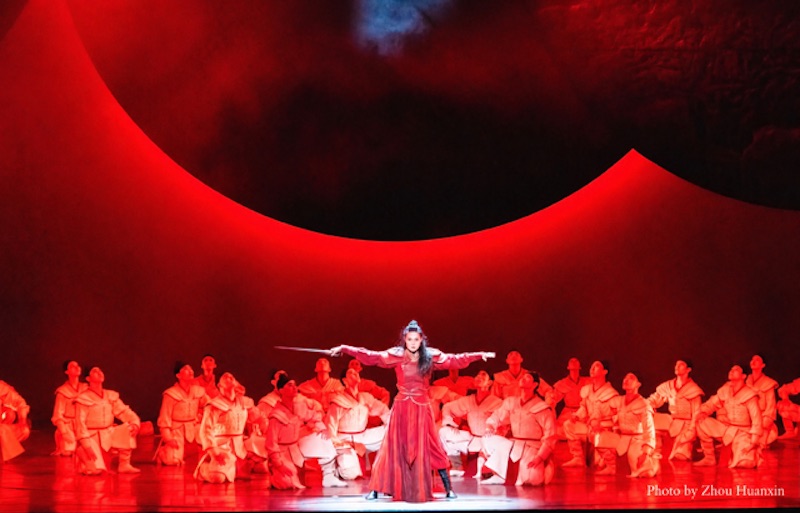
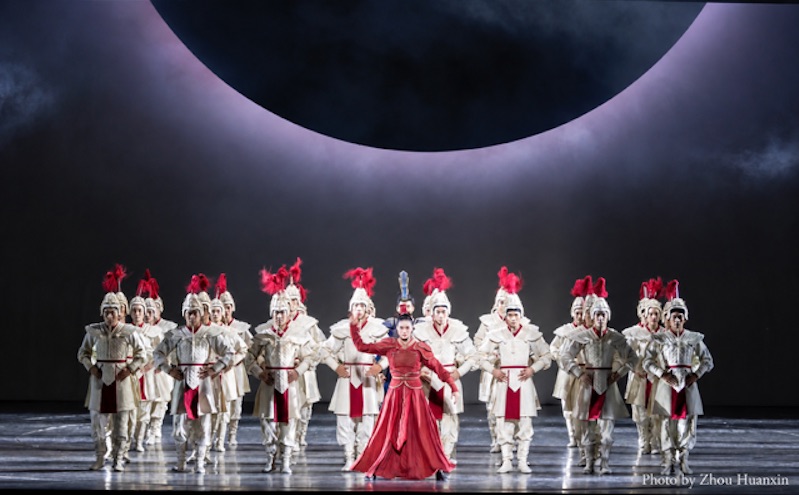
The China Arts and Entertainment Group, a Chinese dance troupe, performed at the David Koch Theater at Lincoln Center. As part of the government-sponsored cultural initiative “Image China,” the troupe presented the dance drama “Mulan,” based on the legendary Chinese epic. This spectacular musical-theatrical show received China’s highest national award, the Lotus Award, and gained worldwide recognition. It is not ballet in the Western sense—rather, it is a fusion of classical Chinese dance, martial arts, and contemporary stage aesthetics. A massive rotating theatrical platform enhances the scale of the battle scenes and the intensity of the drama’s emotional impact. The show’s music blends traditional Chinese instruments and melodies with the sound of a massive symphony orchestra.
“Mulan” is well known in America from the Disney film. But the sentimental American fairy tale for children has little in common with the Chinese tragic war epic about duty and self-sacrifice for the sake of one’s country and family. I watched the production with my grandson; he had seen the American film and was completely confused by the plot development and the characters’ relationships. In essence, the two productions reflect not different directorial approaches, but alternative values and worldviews.
In the original, Mulan does not try to assert her rights, does not analyze her feelings, does not seek glory, and does not get involved in a love story; she responds to the challenges of the times and circumstances in accordance with the national conception of moral obligations. There is a war against a dangerous enemy; her elderly father is unable to take part, and he has no sons. She buys military armor not to show off or prove anything to anyone, but to protect her country. She was raised to be prepared for any twists of fate and to stand in the ranks for the sake of a common cause. Mulan spends 12 years at war, participates in countless battles, and no one suspects that she is a woman. She becomes a general, but when the war ends and, following victory, she is offered the post of Minister of War, she goes out to her comrades-in-arms dressed as a woman and asks for permission to return to her father.
The production naturally elicits mixed reactions—ranging from admiration for the scale and power of the staging to fear and rejection. Critics highly praise the choreography and the drama of the production, singling out soloist Tan Xinyi in particular. The corps de ballet displays superb technical skill and synchrony. The vibrant national costumes contrast with the minimalism of the sets.
Opinions on the musical accompaniment vary. Some see it as an expression appropriate to the concept, while others are outraged by the deafening volume and sonic aggression. Sitting in the center of our sixth row, it was a serious ordeal. Critics believe that for such a manifestation of intentions and prospects, China could have spared no expense to hire a symphony orchestra instead of loudspeakers. I don’t think it’s a matter of cost. The roaring, deafening mechanical sonic aggression is precisely what conveys the essence of the message from a 5,000-year-old civilization to a Western city—and the world—that has lost its way in a fruitless search for the meaning and purpose of its existence.
But the overall verdict is that the performance is a choreographic and visual masterpiece that profoundly and convincingly reveals the Chinese mindset. The audience expressed its admiration with a seemingly endless ovation. The troupe lingered on stage for a long time, and the music thundered on without ceasing. And the headache and fatigue caused by the powerful acoustic assault are not the greatest threat to a Western audience—expecting entertainment and comfort—that comes from China.
I do not think in the terms of a ballet critic, and my impression is primarily tied to the performance’s message. I see in it a direct antithesis to the manifesto of American individualism, *Atlas Shrugged*. Ayn Rand’s formula: Genius owes nothing to anyone. The world owes its existence to geniuses. The hero says: “I swear by my life and my love of it that I will never live for the sake of another man, nor ask another man to live for mine.” Mulan’s formula: The world is held together by duty and obligation to family and country. Atlas sees the state as an obstacle to creative freedom, an adversary. Mulan says: I will give my life for my family and my country.
America has made Randianism a religion. China has made Mulan a Confucian school of life philosophy and morality.
Which worldview and way of life will prevail? The answer won’t be long in coming.

Комментариев нет:
Отправить комментарий